
AI in personal finance 2026 is changing the way everyday people manage money and make smarter financial decisions. Artificial Intelligence is no longer limited to large banks or technology companies. In 2026, AI has become a practical and powerful financial assistant that helps people manage money better, save more efficiently, and invest more confidently. Today, even someone with no finance background can use AI tools to track expenses, create personalized budgets, and receive real-time insights about their spending habits. Instead of guessing where money is going, AI analyzes daily transactions and clearly highlights where unnecessary costs can be reduced—without affecting lifestyle or essential needs.
More importantly, AI helps users build healthier financial habits. From automatic saving recommendations to smart alerts about upcoming bills, AI reduces human errors and emotional decisions that often lead to financial stress. Many modern platforms now use predictive models to forecast monthly expenses, allowing users to prepare in advance and avoid sudden cash shortages. This level of planning was once available only to professional financial advisors, but AI has made it accessible to everyone.
In the investment world, AI plays an even bigger role. Intelligent systems evaluate market trends, historical data, and risk patterns within seconds. This allows individuals to identify suitable investment opportunities based on their personal goals, income level, and risk tolerance. Instead of blindly following social media advice or market hype, users can rely on data-driven insights that improve long-term decision-making.

For freelancers, small business owners, and online entrepreneurs, AI tools also simplify financial reporting and tax preparation by organizing records automatically. As digital finance continues to grow, AI is becoming an essential companion rather than a luxury. In 2026, financial success is no longer defined by how much money you earn, but by how intelligently you manage, protect, and grow it with the support of AI-powered financial tools.
Today, smart finance is not only about how much money I earn.
It is mainly about how intelligently I manage, plan, and protect my money.
In this guide, I explain how I personally use AI-driven systems to improve my financial habits and how this technology can support long-term wealth building.
🚀 AI in Personal Finance 2026 – What It Really Means for Smart Money Management
AI in personal finance 2026 refers to intelligent software that studies my spending behavior, income patterns, financial goals, and daily habits to support better and more confident financial decisions. In simple words, AI in personal finance 2026 works like a smart digital assistant that understands how I earn, how I spend, and where I usually make financial mistakes. Instead of only showing reports, it actively analyzes my data and suggests clear actions such as when to save more, when to control expenses, and how to prepare for upcoming bills.
One of the biggest benefits of AI in personal finance 2026 is personalization. The system learns from my real lifestyle, not from general rules. It notices my recurring expenses, irregular income patterns, and seasonal spending habits, and then adjusts recommendations according to my situation. This makes financial planning far more practical than traditional budgeting apps.
Another powerful feature of AI in personal finance 2026 is predictive analysis. It can estimate future expenses, highlight risky spending behavior, and warn me before my budget goes out of control. This allows me to take action early instead of fixing problems later.
Most importantly, AI in personal finance 2026 helps reduce emotional decisions. By using data, trends, and realistic projections, it supports disciplined saving and smarter investment planning. For beginners like me, this technology makes money management simpler, clearer, and much more achievable without needing professional financial knowledge.
Unlike traditional finance apps that only show reports, AI tools analyze my data and highlight actions I should take.
For example, AI helps me understand:
when I should increase savings,
how much I can realistically invest,
where I am wasting money,
and how to control my monthly budget.
This is the main reason AI is becoming the future of personal money management.
💡Why AI Has Become So Important in 2026
From my experience, the biggest problem people face is not low income. The real problem is poor financial planning, unclear money goals, and a lack of proper guidance at the right time. This is exactly where AI in personal finance 2026 is creating a real difference for everyday people like me. Instead of guessing how to manage money, AI in personal finance 2026 helps me understand my real financial situation using my income, expenses, and lifestyle data.
Many people earn enough, but they still struggle because they do not track spending properly, forget savings goals, and make emotional money decisions. With AI in personal finance 2026, I can clearly see where my money is going, how much I should save, and which habits are silently damaging my budget. It highlights poor spending patterns and gives realistic improvement suggestions based on my own behavior.
Another reason poor planning hurts people is the lack of future visibility. AI in personal finance 2026 uses predictive analysis to estimate upcoming expenses, financial pressure periods, and possible cash shortages. This allows me to prepare in advance instead of reacting late.
Most importantly, AI in personal finance 2026 removes confusion and stress from money management. It transforms weak financial planning into a structured, data-driven system that supports long-term wealth growth and financial stability.
AI solves this challenge in three very practical ways.
Personalization
AI studies my real financial behavior instead of giving general advice.
Speed
It can process large amounts of data within seconds.
Accuracy
It reduces emotional decision-making and focuses on facts, trends, and realistic projections.
Because of this, AI is now useful not only for beginners but also for experienced investors.
🤖 How AI Helps Me Manage My MoneySmart budget planning
AI in personal finance 2026 automatically categorizes my daily expenses and clearly shows where my money is going. It separates my spending into meaningful categories like groceries, subscriptions, bills, entertainment, and miscellaneous costs. By using AI in personal finance 2026, I no longer have to manually track each transaction or rely on spreadsheets. The system highlights unnecessary subscriptions, overspending areas, and hidden recurring charges that I might overlook.
What makes it powerful is that AI in personal finance 2026 does more than just categorize—it analyzes trends over weeks and months to show patterns in my spending. For example, it can indicate that I spend more on dining out during certain months or that my utility bills are gradually increasing. By presenting these insights in one dashboard, AI in personal finance 2026 allows me to take immediate action and make smarter financial choices without feeling overwhelmed.
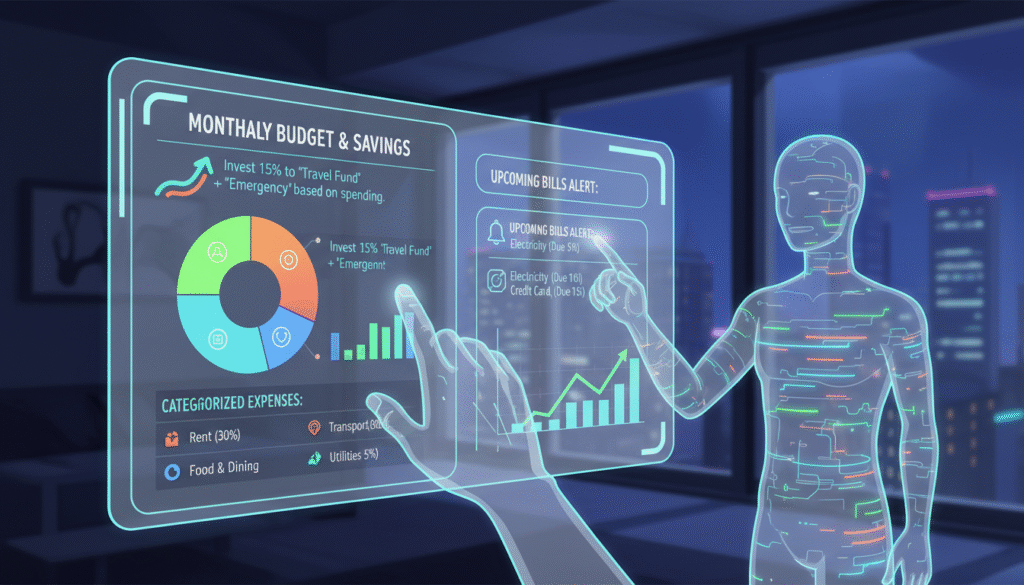
Additionally, the system provides actionable suggestions. It can recommend adjusting spending in specific categories, prioritizing high-value expenses, or shifting savings from low-priority areas. This ensures that every decision I make is backed by accurate, real-time data.
In short, AI in personal finance 2026 transforms messy, confusing financial data into clear, structured insights, helping me save more efficiently, avoid unnecessary spending, and plan for long-term wealth growth effortlessly.
unnecessary subscriptions,
overspending categories,
and hidden recurring charges.
Instead of manually checking spreadsheets, I can see everything in one dashboard.
AI-based saving suggestions
AI helps me decide how much I should save every month based on:
my income,
lifestyle patterns,
upcoming bills,
and past spending history.
It also predicts financial pressure periods and helps me prepare in advance.
Intelligent investment guidance
AI supports investment planning by:
studying historical market behavior,
identifying repeating patterns,
and reducing emotional reactions during market fluctuations.
Many modern platforms use AI models to suggest portfolio adjustments and risk control strategies.
This allows me to make data-driven investment decisions without being a professional trader.
🏦 How Banks and Fintech Companies Use AI in Personal Finance 2026
Banks and financial technology companies use AI for:
fraud detection,
customer behavior analysis,
credit scoring improvement,
and personalized financial products.
Technology companies such as OpenAI are also playing an important role by building advanced AI models that are now being integrated into financial platforms across the world.
📊 How I Use AI for My Finance Blog and Content Strategy
As the owner of a finance website, I also use AI to improve my content workflow.
AI helps me with:
keyword research,
article structure planning,
headline optimization,
and overall SEO improvement.
To understand how readers interact with my website, I regularly analyze my traffic using
Google Analytics.
This allows me to clearly see:
where my visitors come from,
which articles perform best,
and which pages need improvement.
Instead of guessing, I rely on real data to improve my content quality and user experience.
🌍 How AI Helps Me Reach a Global Audience
One of the strongest advantages of AI is global content targeting.
AI tools help me analyze:
which countries search for my topics,
which keywords different regions use,
and what type of content performs best internationally.
This allows me to create articles that are not limited to one country but appeal to readers from multiple regions.
By using AI-driven research, I can position my blog for a global audience and compete with much larger websites.
🧠 Scaling Content With AI and Publishing Platforms
Many finance bloggers, including myself, combine AI assistance with publishing platforms such as
WordPress.
This combination allows me to:
publish consistently,
maintain high content quality,
and manage articles efficiently.
When AI planning, SEO tools, and performance tracking work together, even small creators can compete with large media publishers.
📈 How AI Improves My Financial Decision-Making
One of the biggest risks in personal finance is emotional behavior.
AI reduces this risk by:
using historical financial data,
detecting long-term trends,
and identifying unusual market behavior.
This helps me stay disciplined instead of reacting emotionally to news headlines or social media hype.
⚠ Limitations of AI in Finance
Although AI is extremely powerful, it is not perfect.
I clearly understand that:
AI does not guarantee profit,
AI depends heavily on data quality,
and inaccurate inputs can produce poor recommendations.
Human judgment is still essential.
For me, AI acts as a financial assistant — not a replacement for personal responsibility.
🔮 The Future of AI in Personal Finance

In the coming years, AI will likely evolve into:
fully automated personal finance managers,
predictive saving and investing assistants,
and intelligent risk-monitoring systems.
Soon, most people will no longer manage their finances manually.
AI will become a daily money companion.
AI in personal finance 2026 is helping ordinary people take control of their daily spending, long-term savings, and investment planning using smart and data-driven tools.
With AI in personal finance 2026, money decisions become more accurate, less emotional, and much easier for beginners and non-technical users.
🧩 Final Thoughts
AI in finance is no longer a luxury.
It is becoming a basic requirement for people who want to:
control their spending,
grow their wealth steadily,
plan long-term goals,
and remain competitive in the digital economy.